What is an X-Wing?
An X-Wing appears when a number fits in exactly two cells of two different rows, and those cells share the same two columns — the four corners of a rectangle. The number must sit on one diagonal of that rectangle or the other, so it can be removed from every other cell of the two columns.
Rows and columns can swap roles: two columns whose two spots share the same two rows work the same way, and then you clear the rows. In Marble Sudoku you hunt the rectangle for one marble color at a time.
Use one in 4 moves
- 1Pick. One number at a time.
- 2Rows. Find a row where it has exactly two spots.
- 3Match. Find a second row with the same two columns — a rectangle.
- 4Clear. Remove that number from the rest of both columns.
Then look for singles where you removed it.
TRY IT · GUIDED EXAMPLE
Lock the rectangle
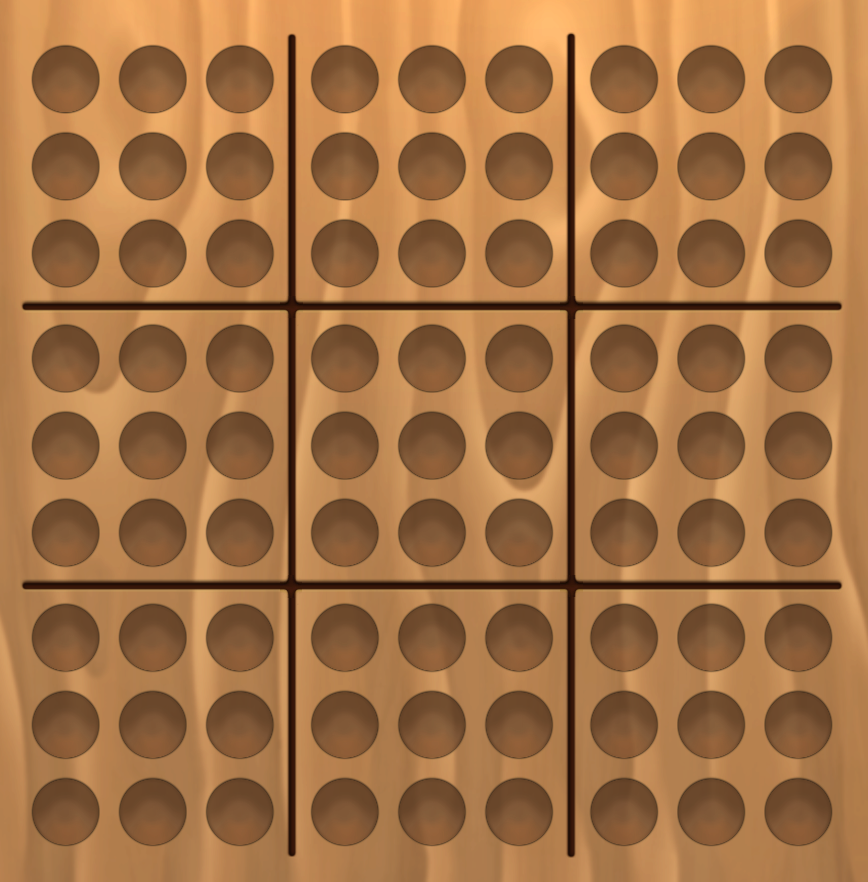
Only Sky is shown in color. Faded Sky marbles mark every hole where Sky could still go. Find Sky’s two spots in each glowing row, match the columns, and clear two lines at once.
 This is the real board from Marble Sudoku. The nine marble colors stand for the numbers 1 to 9.
- Rows
- Rectangle
- Clear
- Place
STEP 1
Lock the rectangle
Read the example in words
Row 1 can only take Sky in columns 7 and 9, and row 5 has exactly the same two spots. Those four corners form a rectangle, so Sky must sit on one of its two diagonals — whichever one is true, both columns get their Sky inside the rectangle. That removes Sky from row 2 column 9, row 8 column 7, and row 9 column 7. Row 2, column 9 is left with a single color: Green. With numbers turned on, Sky is 9 and Green is 5.
YOUR TURN · PRACTICE
Find the rectangles
Each round shows the spots for one color. Tap the four corners when two rows share the same two columns, and watch the rest of both columns clear. On Easy the rows glow. On Hard you find them yourself.
Round color:
Why an X-Wing works
Each row needs every number exactly once. Row 1 has only two free cells for a 9 — columns 7 and 9 — and row 5 has the same two. One of them takes column 7 and the other takes column 9, so both columns get their 9 inside the rectangle, whichever diagonal turns out to be true. No other cell in those columns can hold a 9, so it can be removed.
Swap the roles and the same logic clears rows: if two columns each hold the number in exactly two cells, and those cells share the same two rows, remove the number from the rest of both rows. The pattern lives in rows and columns only — the 3 × 3 boxes play no part.
How to spot X-Wings faster
- Ignore the 3 × 3 boxes completely. Boxes don’t matter here. Only rows and columns do, so scan those.
- Count candidates per number. Pick one number and list its possible cells in every row, like you do for hidden singles.
- Look for numbers with exactly two spots in a row. A row where the number fits in only two cells is half a rectangle. Note its two columns.
- Check one number at a time. The rectangle is much easier to see when you follow a single number across the whole board.
X-Wing vs. pointing pair vs. naked pair
| X-Wing | Pointing pair | Naked pair | |
|---|---|---|---|
| Focus | One number across two rows or columns | One number across one box | Two cells and their candidates |
| Pattern | Two rows share the same two columns | The number’s box spots share a row or column | Two cells share the same two candidates |
| Removes | That number from the rest of both columns | That number from the rest of the line | Both numbers from the rest of the group |
| Needs notes? | Yes, usually | Helpful, but you can scan it | Yes, usually |
Common mistakes
- Corners that don’t share exactly two columns. Both rows must hold the number in the same two columns. Different columns, no rectangle.
- A third spot in a row. If either row has a third cell for the number, the pattern breaks. Each row needs exactly two.
- Clearing the wrong lines. When the rectangle is built from rows, clear the columns — not the rows. The four corners keep the number.
- Treating boxes as constraints. Boxes don’t matter here. Two corners may share a box, or none may — it changes nothing.
X-Wing FAQ
What is an X-Wing in Sudoku?
An X-Wing is one number that fits in exactly two cells of each of two rows, with both rows using the same two columns. The four cells form a rectangle, and the number can be removed from every other cell of those two columns.
Why is it called X-Wing?
Because the two diagonals of the rectangle form an X. The number must sit on one diagonal or the other, whichever turns out to be true. The name comes from the four-winged starfighter the shape resembles.
Can it use columns instead of rows?
Yes. Two columns that each hold the number in exactly two cells, sharing the same two rows, work the same way — then you remove the number from the rest of both rows.
What is a Swordfish?
The 3 × 3 extension of the X-Wing: three rows where the number fits in cells covering the same three columns. It removes the number from the rest of those columns, the same way an X-Wing uses two.
Does this work in Marble Sudoku?
Yes. Pick one marble color, find two rows where it fits in exactly two holes each, and check whether the columns match. If they do, clear the color from the rest of both columns.
Do I need it for easy puzzles?
No. Easy puzzles usually fall to singles and pairs alone. X-Wings earn their keep in harder puzzles, when those methods stop finding moves.

PRACTICE IN THE GAME
Use X-Wings in a real puzzle
When a tough puzzle stalls, pick one color and count its spots row by row. A pair of matching rows is often the move that opens everything up.
Next techniqueHidden Triples