What is a 2-String Kite?
A 2-String Kite is one number with exactly two possible cells in a row and exactly two in a column, where one cell of the row and one cell of the column share a box. That box can hold the number only once, so at least one of the two far ends holds it. Any cell that sees both far ends can’t.
It is a close cousin of the Skyscraper: both use two lines with two spots each. The kite uses one row and one column, joined in a box. In Marble Sudoku you look for it one marble color at a time.
Use one in 4 moves
- 1Pick. One number at a time.
- 2Strings. Find a row and a column where it has exactly two spots each.
- 3Knot. Check that one end of the row and one end of the column share a box.
- 4Clear. Remove the number from the cell that sees both far ends.
Then look for singles where you removed it.
TRY IT · GUIDED EXAMPLE
Fly the kite
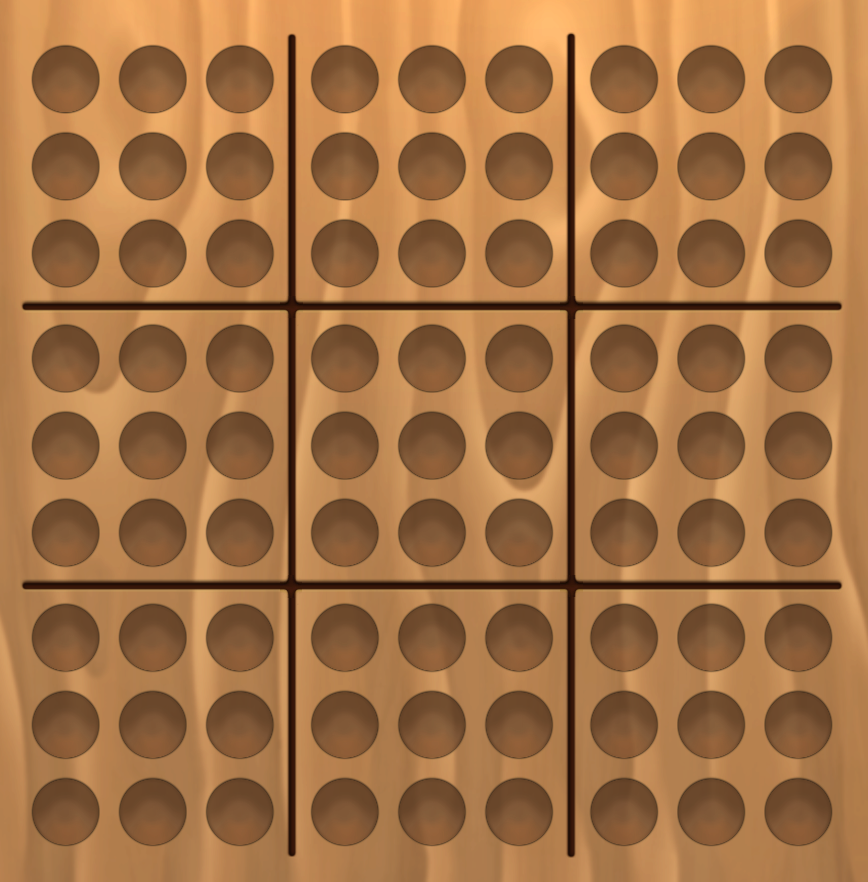
Only Yellow is shown in color. Faded Yellow marbles mark every hole where Yellow could still go. Find Yellow’s two spots in the glowing row and column, tie them in the box, and clear what sees both far ends.
 This is the real board from Marble Sudoku. The nine marble colors stand for the numbers 1 to 9.
- Strings
- Knot
- Clear
- Place
Fly the kite
Read the example in words
Row 1 can only take Yellow in columns 2 and 6. Column 3 can only take it in rows 2 and 8. Row 1, column 2 and row 2, column 3 sit in the same top-left box, which holds only one Yellow, so at most one of them is Yellow. That pushes Yellow onto a far end: row 1, column 6 or row 8, column 3. Row 8, column 6 sees both far ends (one in its column, one in its row), so it loses Yellow and is left with a single color: Orange. With numbers turned on, Yellow is 6 and Orange is 1.
YOUR TURN · PRACTICE
Spot the kites
Each round shows the spots for one color. Tap the four spots of a kite: a row and a column with exactly two spots each, joined in one box. On Easy the lines glow. On Hard you find them yourself.
Round color:
Why a 2-String Kite works
Row 1 needs its 6 in one of two cells, and so does column 3. The two knot cells share a box, and a box holds only one 6. So at most one knot cell is a 6, and at least one string has to put its 6 on its far end instead.
We don’t know which far end it is, and we don’t need to. A cell that shares a row, column or box with both far ends would clash with either one, so it can’t be a 6. If both far ends turn out to be 6, that is fine too: the logic only says “at least one”.
How to spot kites faster
- List the two-spot lines. Pick one number and mark every row and every column where it has exactly two spots. Kites are built only from those.
- Pair a row with a column. Look for one row and one column whose spots meet in the same box, without sharing a cell.
- Find the corner. The cell to clear shares a column with the row’s far end and a row with the column’s far end: the fourth corner of a rectangle.
- Check the box. Both far ends must lie outside the knot box, or there is nothing to remove.
2-String Kite vs. Skyscraper vs. X-Wing
| 2-String Kite | Skyscraper | X-Wing | |
|---|---|---|---|
| Lines used | One row and one column | Two rows (or two columns) | Two rows (or two columns) |
| Where they join | In one box | In one column (or row) | Both ends line up |
| Removes | From the cell that sees both far ends | From cells that see both tops | From the rest of both columns |
| Difficulty | Advanced | Advanced | Advanced |
Common mistakes
- Lines with three spots. The row and the column must each have exactly two spots for the number.
- Sharing a cell. If the row and the column meet in the same cell, it is not a kite. The two knot cells must be different cells in the same box.
- Clearing the knot. The knot cells keep the number. Only the cell that sees both far ends loses it.
- Far ends in the knot box. If a far end is inside the knot box, the pattern removes nothing new.
2-String Kite FAQ
What is a 2-String Kite in Sudoku?
It is a single-number pattern: a row with exactly two spots for a number and a column with exactly two spots for it, where one spot of each sits in the same box. The number can be removed from the cell that sees both of the other two spots.
Why is it called a 2-String Kite?
Draw the row and the column as two strings tied together in a box. The shape looks like a kite with its two strings, and the far ends are where the kite pulls.
Is a 2-String Kite a kind of Skyscraper?
They are close relatives. Both join two strong links of one number. A Skyscraper joins two parallel lines through a shared column or row, a kite joins a row and a column through a shared box. Both belong to the family sometimes called turbot fish.
How many cells can it clear?
Exactly one: the cell in the far end’s column and the other far end’s row. That cell is the only one that sees both far ends outside the box.
Does this work in Marble Sudoku?
Yes. Pick one marble color, find a row and a column with exactly two holes for it that meet in one box, and remove the color from the hole that sees both other ends.
When should I look for one?
After singles, pairs, box/line reductions and X-Wings stop finding moves. Kites are quick to check once you list the two-spot lines for a color.

PRACTICE IN THE GAME
Fly a kite in a real puzzle
When a hard puzzle stalls, pick one color and list the rows and columns with only two holes for it. A row and a column that meet in a box often break the puzzle open.
Next techniqueEmpty Rectangle