What is a Swordfish?
A Swordfish appears when, in three different rows, a number can only go in cells that all lie in the same three columns. Those three rows must place the number in those three columns, one each, so every other cell of the three columns loses it.
It is the bigger sibling of the X-Wing: three rows and three columns instead of two. Each row may have only two of the three columns, which makes it harder to see. Rows and columns can swap roles. In Marble Sudoku you follow one marble color at a time.
Use one in 4 moves
- 1Pick. One number at a time.
- 2Rows. Find three rows where it has only two or three spots.
- 3Match. Check that all those spots fit in the same three columns.
- 4Clear. Remove the number from the rest of those three columns.
Then look for singles where you removed it.
TRY IT · GUIDED EXAMPLE
Catch the Swordfish
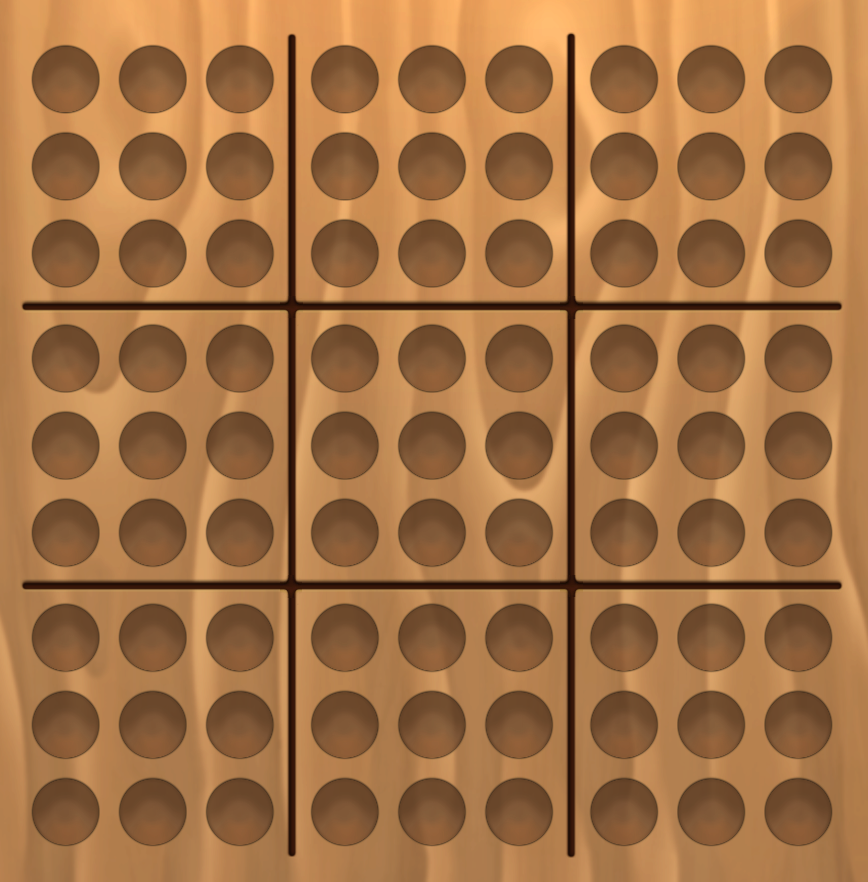
Only Navy is shown in color. Faded Navy marbles mark every hole where Navy could still go. Tap Navy’s spots in each glowing row, see that they fit in three columns, and clear those columns.
 This is the real board from Marble Sudoku. The nine marble colors stand for the numbers 1 to 9.
- Rows
- Columns
- Clear
- Place
Catch the Swordfish
Read the example in words
Row 4 can only take Navy in columns 1 and 8, row 5 only in columns 1, 7 and 8, and row 8 only in columns 7 and 8. All seven spots lie in columns 1, 7 and 8. The three rows need three Navys, and each of those columns can hold only one, so the three columns get their Navy from these rows. That removes Navy from row 1, column 7 and from row 3, column 8. Row 1, column 7 is left with a single color: Orange. With numbers turned on, Navy is 8 and Orange is 1.
YOUR TURN · PRACTICE
Find the Swordfish
Each round shows the spots for one color. Tap every spot in three rows whose spots fit in just three columns, and watch those columns clear. On Easy the rows glow. On Hard you find them yourself.
Round color:
Why a Swordfish works
Each row needs every number once. Rows 4, 5 and 8 can only place their 8 in columns 1, 7 and 8. Three rows need three 8s, and they must land in three different columns, because two 8s in one column would clash. So columns 1, 7 and 8 each get exactly one 8 from these rows.
A column holds only one 8, so no other cell in those columns can be an 8. It doesn’t matter that two of the rows use only two of the three columns: together they still cover all three. The boxes play no part.
How to spot a Swordfish faster
- Follow one number. List the spots for one number in every row. Rows with only two or three spots are your candidates.
- Look for shared columns. Write down the columns of those spots. Three rows that use only three columns between them make a Swordfish.
- Expect gaps. A Swordfish row often has just two of the three columns, a 2-2-2 shape. Don’t wait for full rows of three.
- Try columns too. Swap rows and columns: three columns whose spots fit in three rows clear the rest of those rows.
Swordfish vs. X-Wing vs. Jellyfish
| Swordfish | X-Wing | Jellyfish | |
|---|---|---|---|
| Lines | 3 rows and 3 columns | 2 rows and 2 columns | 4 rows and 4 columns |
| Spots per line | 2 or 3 | Exactly 2 | 2 to 4 |
| Removes | The number from the rest of 3 columns | The number from the rest of 2 columns | The number from the rest of 4 columns |
| How often | Hard puzzles | Hard puzzles | Rare, expert puzzles |
Common mistakes
- A fourth column. If any spot of the three rows lies outside the three columns, there is no Swordfish.
- A row with four spots. Each row may have two or three spots, never more, and all of them must be in the three columns.
- Clearing the rows. When the Swordfish is built from rows, clear the columns. The spots in the three rows keep the number.
- Missing an X-Wing. If two of the rows alone fit in two columns, you have an X-Wing. Use that first: it’s simpler.
Swordfish FAQ
What is a Swordfish in Sudoku?
A Swordfish is one number that, in three rows, can only go in cells within the same three columns. The number can then be removed from every other cell of those three columns.
Why is it called Swordfish?
It belongs to the “fish” family of patterns named after the X-Wing: Swordfish for three lines, Jellyfish for four. The names are playful and don’t describe the shape.
Does every row need three spots?
No. Each row needs two or three spots, and all of them must lie in the three columns. The common 2-2-2 Swordfish has only two spots per row.
Can it use columns instead of rows?
Yes. Three columns whose spots for a number fit in the same three rows work the same way, and then you clear the rest of those rows.
Does this work in Marble Sudoku?
Yes. Pick one marble color, find three rows with two or three holes for it, and check that those holes fit in three columns. Then clear the color from the rest of those columns.
Is a Swordfish rare?
It is less common than an X-Wing but shows up regularly in hard and expert puzzles, often when nothing else is left.

PRACTICE IN THE GAME
Catch a Swordfish in a real puzzle
When a hard puzzle stalls, follow one color across all nine rows and note where it can still go. Three rows that share three columns are a Swordfish waiting to clear the board.
Next techniqueSkyscraper