
TRY IT · GUIDED EXAMPLE
Find the home for Green
The center box is missing a Green marble. The other colors are dimmed so the Green marbles stand out. Tap the Greens whose row or column crosses the box and watch them block holes.
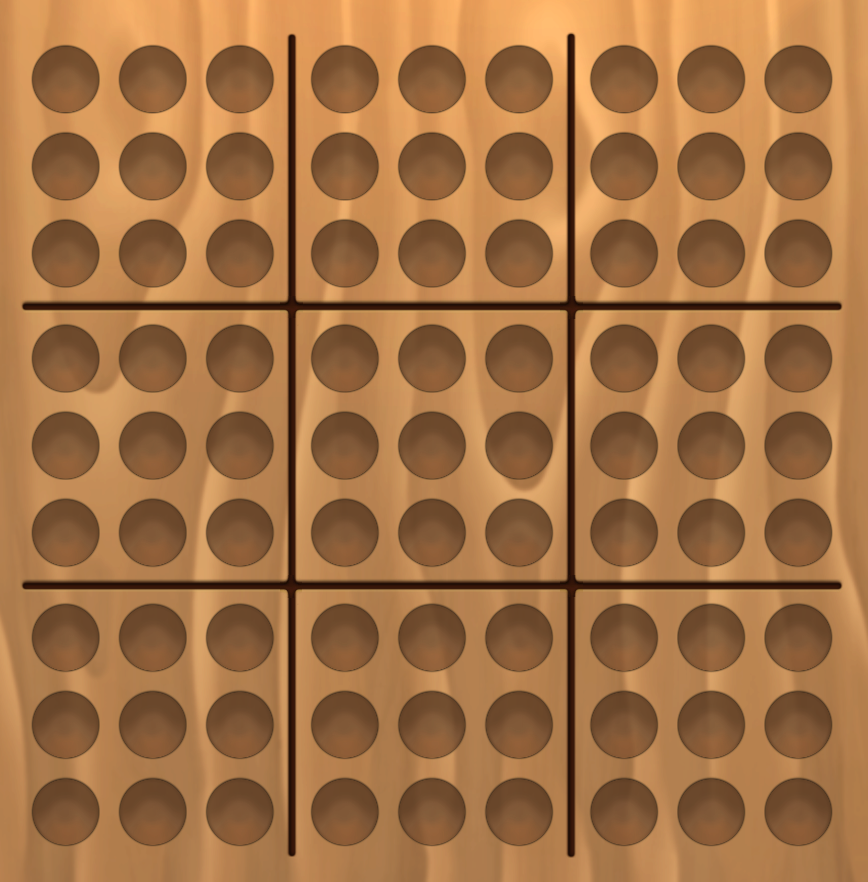
 This is the real board from Marble Sudoku. The nine marble colors stand for the numbers 1 to 9.
- Scan
- Place
STEP 1
Find the home for Green



Read the example in words
The center box is missing Green and has four empty holes: two in row 4 (columns 4 and 6) and two in row 5 (columns 4 and 6). The Green in row 4, column 1 blocks both holes in row 4. The Green in row 3, column 4 blocks the column 4 holes. Only the hole in row 5, column 6 is left, so Green goes there. That hole could also hold Red, Teal or Navy, so you would not find it by checking the hole alone. With numbers turned on, Green is 5.
YOUR TURN · PRACTICE
Scan for hidden singles
Pick a color in the tray: its marbles light up and the rest dim. Then tap the hole where it must go. A move only counts if that color has just one hole left in the hole’s row, column or box. Every puzzle is new and can be solved with singles alone.
SCAN FOR A COLOR
Why a hidden single always works
Every row, column and 3 × 3 box must contain each number exactly once. If a box is missing a 4, the 4 has to go in one of its empty cells. A cell is blocked for 4 when a 4 already sits in that cell’s row or column (or box). Block every option but one and the 4 has nowhere else to go.
Nothing here depends on what else the cell could hold. That is the difference from a naked single, where you prove a cell has only one possible number.
How to scan faster
- Start with the most common number. A number that is already placed 6, 7 or 8 times has the fewest free spots left, so its hidden singles are easiest to see.
- Go box by box. For one number, visit each box that is still missing it and draw imaginary lines from the copies in neighboring rows and columns. This is called cross-hatching.
- Check rows and columns too. A number can be hidden in a row or column even when no box shows it yet.
- Rescan after every placement. Each new number sends out a new row and column line, which often creates the next hidden single.
Hidden single vs. naked single
| Hidden single | Naked single | |
|---|---|---|
| Question you ask | Where can this number go in this group? | Which numbers can go in this cell? |
| You look at | One group and all of its empty cells | One cell and its row, column and box |
| It is found when | The number has one possible cell left | The cell has one candidate left |
| Other candidates in the cell? | Often yes, and that is fine | None |
Common mistakes
- Forgetting the box. A cell can also be blocked because its own box already holds the number.
- Mixing up groups. All the blocked cells must belong to the same row, column or box you are checking.
- Stopping at two cells. Two free cells means the number is not placed yet. Note it and move on.
- Not rescanning. Hidden singles often come in chains. After each placement, check the same number again.
Hidden singles FAQ
What is a hidden single in Sudoku?
A hidden single is a number that can go in only one cell of a row, column or 3 × 3 box. Every other empty cell in that group is blocked for the number, so it must go in the remaining cell.
Why is it called a hidden single?
Because the cell itself may still have several candidates. The single is hidden among them, and you only see it when you scan the whole group for one number.
What is cross-hatching in Sudoku?
Cross-hatching is the scanning method for hidden singles: for one number, you trace the rows and columns of its existing copies through a box until only one free cell is left.
Is a hidden single harder than a naked single?
Both are beginner techniques. Many players find hidden singles quicker to spot without notes, while naked singles are easier to see once candidate notes are written in.
Do I need pencil marks for hidden singles?
No. Hidden singles are usually found by scanning, without notes. Notes can help on harder grids: a number that appears in only one note of a group is a hidden single.
Does this work in Marble Sudoku?
Yes. Marble Sudoku uses nine marble colors instead of the numbers 1 to 9. Pick a color, and look for the one hole in a row, column or box where it can still go.

PRACTICE IN THE GAME
Scan for hidden singles in a real puzzle
Every Marble Sudoku puzzle is built on the same marble board you just used. Pick a color, scan the boxes and watch the last hole light up.
Next techniqueNaked pairs